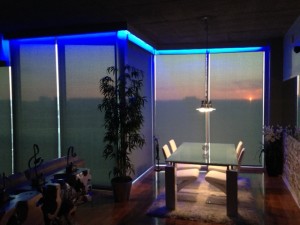
Terminus Buckhead Atlanta, GA Solar Screen Installation

One of our installers has picked up an old habit. Luckily it’s photography. He sent me some shots from a recent installation at Terminus and I just had to share these with you. Turns out, these will make a great post for showing how we can inter-cut shades into a challenging ceiling and still make everything look great.

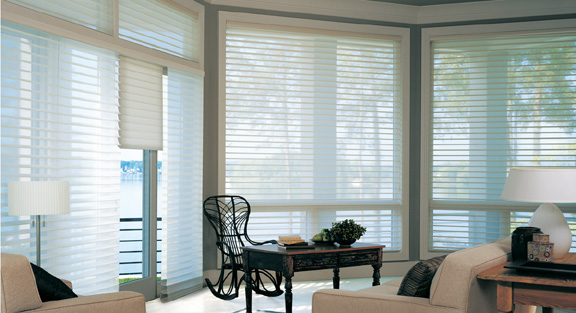
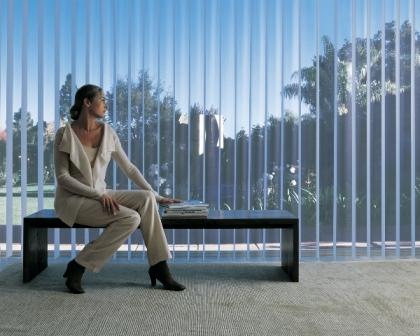
In this first photo, you receive a great sense of how solar screen shades can help control light, heat, and glare while beautifying a room. The shades in these photos are made by Lutron. The fabric is a Phifer SheerWeave 3% called Oyster/Charcoal. It is a weave of white and black strands of fabric that allows 3% of the light to shine through. As you can see, the shaded parts of the shade are easier to see through than the portions that are in direct sunlight. This is caused by the diffraction of the light as it passes through the fabric. There is a trade off between shade color and diffraction as well as openness factor (3%, 5%, 10%, etc.)


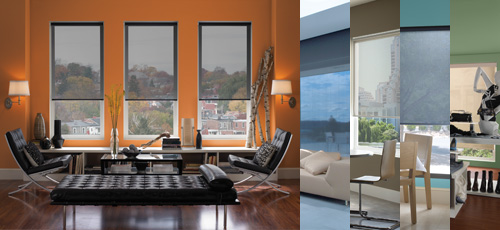
In this photo, you can see the challenges of working with ceilings of varying heights. The simple roller shade is a good fit in this instance. Horizontally slatted or patterned products like Silhouette, Pirouette, Vignette and blinds and shutters do not work well here as it is very difficult or impossible to align the patterns since the products are indexed from the top. In other words, the slats wont line up from left to right. Also, we have to take into account the interplay of the vertical mullions and their relationship with the shade and the changes in the ceiling. All of these factors must be considered when endeavoring to design a job of this nature.


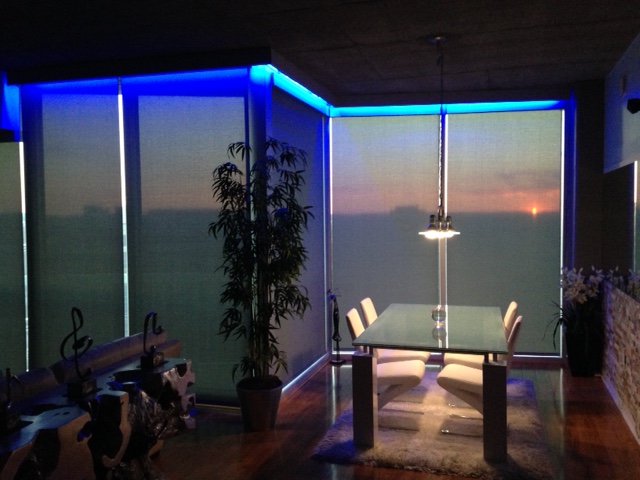
Here you can see another important challenge when working with “storefront” glass systems: corners. These can be very challenging however, not impossible to solve. As long as the designer and the client are in communication, this usually works out. In our installation at the Terminus, we chose the “butt and pass” design. One shade butts into the other as it passes. This works well, however; it does create a gap as you can see. The best way to design this is to take into consideration the sight lines in the room, the lay of the room in relation to the sun’s movement, if there is a media device that may be effected (i.e. TV’s and such), and how it will look. Our client chose this design based mainly on how it would look from the center of the room. We had suggested the opposite design due to how the sun will come through the gap in the middle of the day, however; the “look” was more important to her so we went with her choice. She is happy and that is all that matters.

A final challenge with many “high-rise” installations as you may have noticed in our pictures is the unevenness of the ceilings. This is just the way things are. Typically the ceilings are plastered concrete and the concrete is never level. We have to hang the shades so that they are plumb and parallel to the vertical mullions. Notice, I didn’t write “walls” as these are usually wavy as well. We are experts, however; we are not magic. If these gaps and wiggles are going to drive you nuts, then we should also install fabric valances and side panels that are soft and will fill in the gaps. Other solutions include rigid side channels that the shades can ride inside and they can be caulked from behind with light seal caulk. The ceiling gaps can also be dealt with in a similar fashion but not always.

Well, that’s my rant on roller shades for storefronts and high-rises. I hope it has been informative and slightly entertaining. If you have more questions or concerns, please give me a call. 770-512-0206 or email me at jsmith@atlantablinds.com

Park Place Residence Lutron Sivoia QED Installation

This is a job we installed about four years ago, however; it is a great example of dual shade, Curtain Wall 200 and adding a timer. Enjoy!

Click here to go to YouTube to watch the video.


Repairs

Here is our policy on repairs:

If the product was not purchased from us – we do not offer repair service.

Spare Parts (i.e. valance clips, hold down brackets, cord tassels, etc.) We do not carry spare parts for any product. If it is a product purchased from us we will do our best to have parts shipped to you by the fabricator.

Products purchased from Atlanta Blind & Shade – We stand behind our fabricators’ warranties and will be happy to help you obtain the warranty repair that you are expecting. Here is what is covered and how this works:

  • Any product purchased from Atlanta Blind & Shade carries a lifetime limited warranty for the original purchaser that is specific to each manufacturer/fabricator. The policies of each fabricator vary however, the basic gist is that it is covered for as long as it is owned by you.
    • The product should be free from “manufacturing defect”. The product should perform as advertised and should not just fall apart. The “limited” part of Limited Lifetime Warranty refers to the fact that normal wear and tear, misuse and just plain old accidents aren’t covered. However these issues can still sometimes be remedied via repair. Most repair charges are minimal. Usually less than $100.
    • Labor and shipping are NOT covered in the cost of warranty or non-warranty repairs. We do our best to make this as easy and as cost effective as possible for the consumer by providing the RGA (Return Goods Authorization) number from the fabricator and the shipping address to the manufacturer so that you can get your product repaired as quickly and cheaply as possible. Most of our fabricators provide free shipping back to the consumer once the product is repaired.
    • Labor to remove and/or re-install the product from/to the window is not covered by the warranty. This labor is typically $75 per trip to the consumer’s home by someone from our staff. Shipping to the fabricator is the responsibility of the consumer and is not included in the warranty. We will be happy to ship the product for you at an additional cost.
    • Batteries for motorized products aren’t covered under warranty. If you would like us to help you change your batteries we will be glad to do this for a fee.

So, how does this really work? Well, if you have a product that YOU purchased from us and want us to come and take it down, ship it to the fabricator, and re-install it once it is returned to you by the fabricator, it looks like this:

$75.00 trip to your home to uninstall.

$??.?? cost of shipping to the fabricator.

$75.00 trip to your home to reinstall.

If the product was purchased from us by someone else (i.e. the people you purchased your home from), the above charges would be the same plus whatever the repair cost from the fabricator may be.

QMotion continues to amaze me

I first wrote about this amazing new battery operated roller shade about a month ago and stated that it is one of the first products to come along in a while that has really caught my attention. Well, it is REALLY amazing! Everyone I have shown it to has either bought it or is saving up to buy it. They are as slack jawed about it as I am. Maybe they’re just picking up on my awe … I don’t know.

QMotion battery powered radio controlled shades

QMotion battery powered radio controlled shades

Here’s what’s blowing my mind:

  • How quiet it is. Lutron has always been my standard for quiet but QMotion is right there with them.
  • How simple it is. No wires, no antennas, just two brackets and a shade … and a fabric wrapped cover if you want.
  • How long the batteries will last. FIVE years!
  • Mermet fabrics. Smart choice QMotion.
  • The price. Still not the cheapest BUT definitely not the most and worth every penny. You get what you pay for folks.
  • Delivery. Three weeks! That’s it!

I could go on and on but I think you get the point. Give us a call today for a free demonstration. It will blow your mind … too.

Jayson Smith, CEO

Save Energy In Style Sale from Hunter Douglas